
The Science of Human Possibility
HUMAN CONNECTION UNLOCKS HUMAN POSSIBILITY
A Paradigm Shift
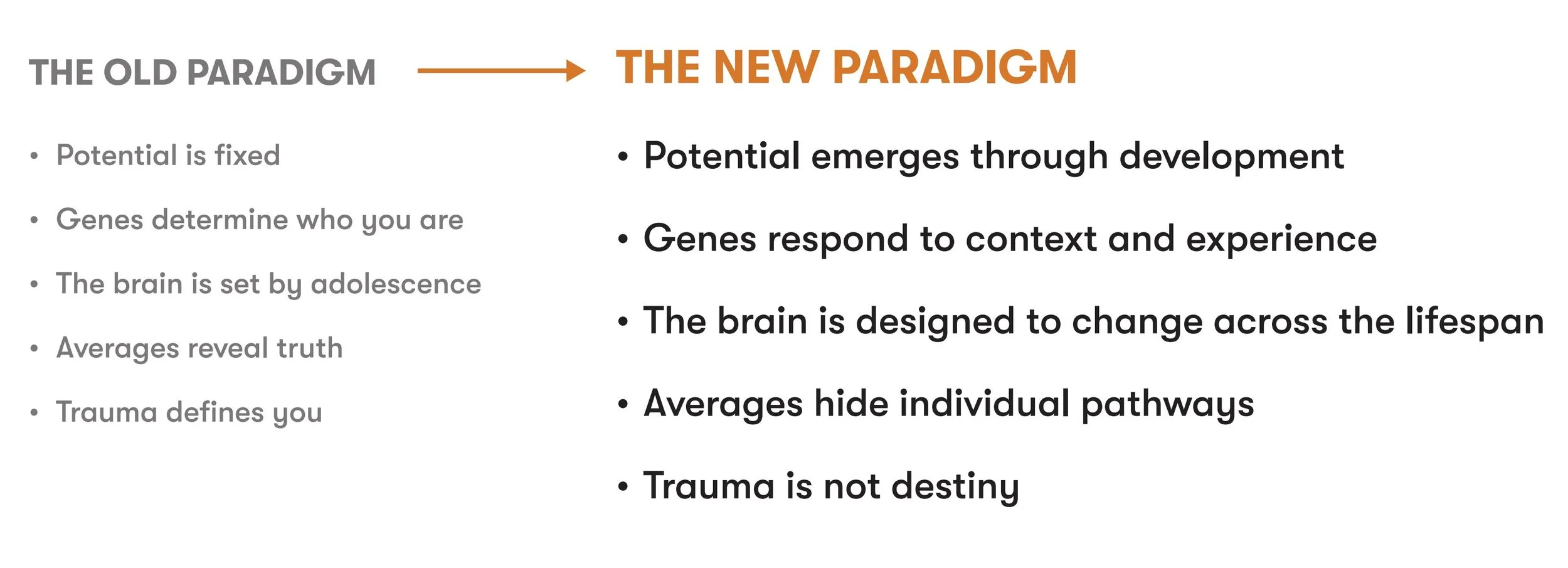
We are on the cusp of a paradigm shift. For over a century, we have operated under a bell-curve model of human potential—the idea that we can know, sort, and cap what a person is capable of in advance. This belief has justified tests, tracking systems, and early selection that constrain human development on a national scale. But the emerging science tells a different story: human potential is not fixed at birth. It is built through experience. And the single most powerful experience that shapes our biological capacity to learn, grow, and thrive is human connection.
Human Development as a Dynamic System
The science behind this claim rests on understanding human development as a dynamic system. Dynamic developmental systems have three essential properties: they are non-linear, meaning small inputs can produce large effects and outcomes are not proportional to causes; they are bi-directional, meaning influence flows in multiple directions simultaneously rather than from genes to behavior in a one-way path; and they are integrated, meaning the components work together as a unified whole rather than as isolated parts. The brain and the genome are two powerful examples of dynamic developmental systems—both are shaped by experience across the lifespan, and both will be described in detail below.
The Causal Chain: From Connection to Capability
Decades of research in neuroscience, developmental psychology, and epigenetics now converge on a simple but profound insight: there is a biological pathway through which relationships shape who we become. That pathway looks like this:
CONNECTION → NEUROCHEMISTRY → BLOOD FLOW → ENERGY → INTEGRATION → CAPABILITY
Human connection triggers a cascade of neurochemical signals—oxytocin, dopamine, endogenous opioids—that regulate how blood flows to the brain and how energy is distributed across neural networks. This energy enables the integration of brain systems. And integrated brains are what make learning, emotional regulation, creativity, resilience, and moral reasoning possible. Connection is not merely nice to have. It is the biological fuel for human development.
The Biology of Human Connection
The human brain evolved as a social organ. We are the most socially dependent species on the planet, and our nervous systems are designed to develop in relationship, function in relationship, and flourish in relationship.
When connection is present, it triggers specific biological responses. Oxytocin—released through eye contact, physical touch, and attuned interaction—reduces threat perception and opens the brain to learning. Dopamine provides the reward signal that makes connection feel good and motivates us to seek it. Endogenous opioids create the sense of comfort and wellbeing we feel in close relationships. These neurochemicals don't just make us feel better. They change how the brain operates, shifting it from defensive mode to growth mode.
Connection also regulates the stress response system. The presence of a trusted other literally buffers the body's cortisol response, protecting the brain from the toxic effects of chronic stress. This is why adversity without supportive relationships is so damaging, and why the same adversity with supportive relationships can be navigated without lasting harm. The relational context determines the biological impact.
Perhaps most remarkably, our bodies synchronize with those we are connected to—heart rates align, breathing patterns coordinate, hormones rise and fall together. This physiological synchrony, which begins between infants and caregivers, is how we learn to regulate ourselves. We borrow the regulatory capacity of others until we build our own. Self-regulation is not something we develop alone. It emerges from co-regulation.
How the Brain Gets Built
The brain is an electrical structure, and its primary energy source is human connection. This is not metaphor—it is biology.
The brain consumes 20% of the body's energy in adults and up to 60% in young children, yet it cannot store fuel. Every moment of neural activity depends on glucose and oxygen delivered through blood flow. When we feel safe in connection, the neurochemicals released—particularly oxytocin—optimize how blood flows to regions responsible for learning, memory, and complex thought. When we feel threatened or isolated, blood flow shifts toward survival circuits, and the resources available for growth diminish.
The brain is also extraordinarily plastic—it physically changes in response to experience for both good and bad. Synapses strengthen or weaken, new connections form, and neural networks become more or less integrated based on the environments and relationships we encounter. The brain is not a fixed organ that unfolds according to a genetic blueprint. It is a dynamic system that is literally constructed through interaction with the world—especially the social world.
Integration—the linking of differentiated brain regions into a coherent whole—is the mechanism through which human capability emerges. Integrated brains can regulate emotion, sustain attention, think flexibly, and recover from setbacks. And what produces integration? Relationships that are consistent, responsive, and attuned. This is why trauma is not destiny—we can heal. The same circuitry that repairs also strengthens, the one that strengthens performs and the one that performs can flourish.
How Experiences Shape Gene Expression
The malleability of human potential extends even to our genes. For decades, we assumed that genes were fixed instructions—a biological destiny written at conception. We now know this is wrong. Genes are not static commands. They are regulated—their expression can be sped up, slowed down, or silenced altogether based on the experiences we have across our lifetimes.
This is the science of epigenetics: experience changes which genes get expressed and when. Diet, exercise, light exposure, and stress all affect gene expression. But so does social interaction. Research demonstrates that the quality of early caregiving, social status, and even self-perceived loneliness can modify how genes function—not by changing the DNA sequence, but by changing which genes are turned on or off.
This has profound implications. If biological characteristics as fundamental as gene expression are shaped by experience, then the behaviors and mental abilities we consider "trainable" are at least as open to environmental influence. This is precisely why we cannot make accurate predictions about psychological traits based on genomic information or measurements taken in infancy. An intelligence test given to a child will never accurately predict where that person will be when they reach middle age. There are simply too many unpredictable factors—including relationships, environments, and experiences—that will influence mental activity and behavior in the intervening years.
From Selection to Cultivation
This science dismantles the old paradigm. If human potential is built rather than fixed—if experience shapes not only our brains but even our gene expression—then the entire logic of early testing, tracking, and sorting collapses. These systems don't reveal potential—they constrain it. They become self-fulfilling prophecies that deny opportunity to those who need it most.
What replaces the old paradigm is a shift from a culture of selection to a culture of cultivation. Instead of asking who has potential, we ask what conditions allow potential to be realized. Instead of sorting people, we invest in environments and relationships that build capability. The science is clear: when biological expectations are met—when people have access to consistent, supportive relationships and environments that reduce toxic stress—the brain develops the integrated architecture that enables learning, resilience, and flourishing.
This is not wishful thinking. It is neurobiology and epigenetics. The same plasticity that allows adversity to harm allows intervention to heal. Change remains possible across the lifespan because the brain and even our genes never stop responding to experience.
Implications
The Science of Human Possibility has profound implications for how we design schools, workplaces, communities, and policies. It tells us that relational quality is not a soft variable—it is a biological necessity. It tells us that inequality is not just unjust but biologically injurious, because it systematically denies some people the developmental conditions their brains and genes require. And it tells us that the path to unlocking human potential runs through the biology of human connection—in families, classrooms, organizations, and societies.
The Human Potential L.A.B. is the missing infrastructure between what science now knows about human development and the systems responsible for it. Our narrative change work, including field publications, practitioner tools, and Dr. Cantor's forthcoming book SPARK: How Human Connection Unlocks Human Possibility, carries that case into the broader public conversation, building the demand that systemic and culture change requires.
We take what decades of research in neuroscience, epigenetics, and developmental psychology have made clear about connection, capability, and growth, and turn it into something institutions can actually use: frameworks grounded in biology, tools built for real contexts, and partnerships that test and prove the work.
The question is no longer whether this science is true. The question is whether we will act on it—whether we will build a world that cultivates rather than selects, that invests in connection rather than competition, and that finally treats human possibility as the renewable resource it is.
